A survey out this week found that 78% of business owners don't fully trust AI to handle even low-level tasks without supervision. Fair enough — trust is earned. But here's the twist: the same survey found Claude is the fastest-growing AI tool among small businesses, up 729% year over year. Owners aren't waiting for perfect trust; they're building it one task at a time.
This issue is about the biggest trust unlock we've seen yet — your AI can now log into your accounts without ever seeing your passwords — plus a smarter way to pick which AI model you're actually paying for, and a lead magnet upgrade you can build without writing code.
Field NoteThe week the model wars got practical
It was a big week for new model releases — OpenAI shipped its GPT-5.6 family (three versions: Sol, Terra, and Luna), joining Claude Fable 5 at the top of the charts. Here's where they all land on capability versus cost per token:
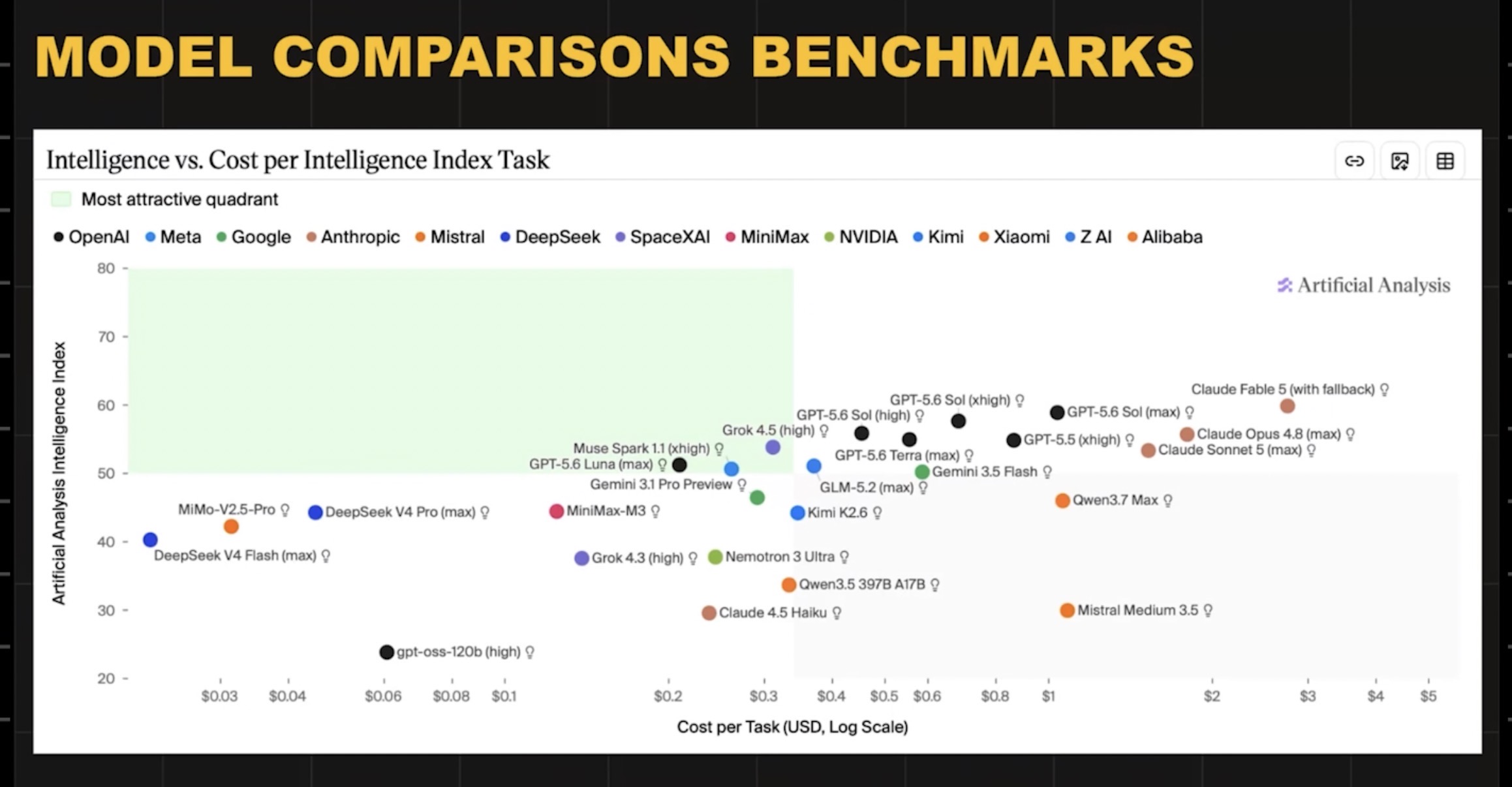
Ignore the benchmark scores; here's the part that matters for your business. You don't need the smartest model for everything — you need the cheapest model that clears the quality bar for each job. Everyday email and admin? A mid-tier model is plenty. A pricing decision or contract analysis? Pay up for the top tier — being right matters more than the pennies. High-volume routine work? The cheap, fast tier wins. The test is simple: run the same real task through two models and compare the finished result, correction time, and price. Your invoice is a better benchmark than anything on that chart.
And one piece of release-week news that actually touches your subscription: Anthropic just ended the will-they-won't-they on Claude Fable 5 — the model sitting in that chart's top-right corner. After weeks of temporary extensions, Fable 5 became a permanent part of Max and Team Premium plans on July 20, capped at 50% of your normal usage. That matters because Fable 5 is Anthropic's most capable model, a full tier above the Opus line — and the difference shows up on exactly the work you feel: long contracts, deep analysis, multi-step projects where lesser models lose the thread halfway through.
Practically: if you're on Max or Team Premium, do your heavyweight thinking with Fable first — the pricing decision, the contract review, the plan you'll bet the quarter on — and when you hit the cap, Opus 4.8 and Sonnet 5 are still there to carry the routine work for the rest of the cycle. On Pro or Team Standard? Fable stays pay-as-you-go: Anthropic is adding a one-time $100 usage credit, and once it's spent, continued access is metered. Translation: spend that credit on your hardest problems, not your email.
Tool SpotlightYour AI can use your passwords — without seeing them
Every owner who's tried to hand real work to an AI has hit the same wall: the login screen. You either type your password into something you don't fully trust, or you stop the automation and do it yourself.
As of this week there's a third option. 1Password for Claude lets Claude log into websites using credentials stored in your 1Password vault — and the password never enters the AI's memory, context, or Anthropic's systems. When Claude reaches a login, 1Password shows you exactly which credential it wants and why. You approve with a fingerprint. 1Password injects the login through a separate secure channel. Claude knows it's logged in; it never knows what it typed. Access lasts for that one task only.
That means the jobs you've been holding back — pull the numbers from the ad platform, check the vendor portal, gather the reports for month-end — are now on the table without handing over the keys. It's live now for 1Password users on Mac, working with the Claude desktop app and browser extension.
Our advice for week one: start with one read-only task in one low-risk account. Ask it to retrieve something, not change anything. Build from there. Details at 1password.com/blog/1password-for-claude. Want help deciding which of your logins should ever touch an agent — and which never should? Talk to us.
The Little SecretThe one-decision notebook
Google's NotebookLM (just renamed Gemini Notebook) has quietly become the best free decision-support tool available — and this ten-minute setup is how to use it.
Create one notebook for one decision you're wrestling with right now. Don't upload your whole digital attic — load a clean box of evidence: your last six monthly reports, notes from your best and worst sales calls, customer survey responses, your current offer next to three competitor offers. Then ask three questions: "What pattern would I miss reading these one by one?" — "Which conclusion has the strongest evidence?" — "What should I stop, start, or test next?"
The answers stay grounded in your documents instead of the internet's average opinion. And as of this week, notebooks are getting the ability to run actual analysis on your files — charting trends, calculating which customer type stays longest — not just summarizing them.
Connect the Dots: your marketing copy + your support inbox. Marketing records what you promise. Support tickets record what customers say you didn't deliver. In most businesses those live with different people and are never read side by side.
Load both into one Claude project — your website copy and recent campaigns on one side, a quarter of support emails on the other — and ask: "Where do the promises and the complaints overlap?" Every match is one of two fixes: a copy fix (stop promising it) or a product fix (start delivering it). Either one reduces refunds, churn, and awkward phone calls. The decision it changes: what your homepage says by Friday.
Claude Skill of the WeekSuperpowers: for everyone who's caught the vibe-coding bug
What's a skill? A downloadable instruction pack that teaches Claude to do a specific job your way — like handing a new hire a perfect training manual. Install it once, and that expertise is on your team permanently.
This week's pick: Superpowers — for everyone who's caught the "vibe coding" bug.
Here's the problem it solves. More owners than ever are building their own tools with AI — a quote calculator, a client portal, an internal dashboard. And most of those tools work beautifully until the third change request, when the whole thing quietly falls apart. That's because the AI dove straight into writing code without a spec, a plan, or tests.
Superpowers makes that impossible. Install it, and the moment you ask Claude to build something, it stops and interviews you first — what is this for, who uses it, what does done look like? It shows you the plan in plain-English chunks for sign-off before writing a line. Then it builds test-first, reviews its own work, and sticks to the plan — often working correctly for hours without drifting. It's the difference between an enthusiastic intern winging it and a process that produces something you can still modify in six months.
How to get it: in Claude Code, type /plugin install superpowers@claude-plugins-official — it's on Anthropic's official plugin marketplace (github.com/obra/superpowers, free, MIT-licensed). If that sentence meant nothing to you but you have a tool you wish existed, reach out — building durable little tools for businesses is exactly what we do.
Try this prompt: "Let's build a simple project-status page my clients can check." Then watch it ask you questions before writing any code. The questions are the product.
Worth KnowingTwo headlines that matter this week
- Canva can now build you a calculator, quiz, or mini-app — free. Canva Code 2.0 opened to all users this week: describe the tool in plain English, edit it in the drag-and-drop editor you already know. The best lead magnets are shifting from PDFs to interactive tools. (Coverage)
- Visa, Mastercard, Google, and Stripe just agreed on how AI agents will pay for things. Translation: within a year or two, some of your customers will be software — and websites agents can't read won't make the shortlist. (Announcement)
Get the next issue in your inbox.
One email every two weeks — practical AI for small business owners. Free, and the forwarding kind of good.
Subscribe free →