I remember the first time I used ChatGPT. I sat there for a minute after, not doing anything, just feeling it. Something had shifted, and I knew the world on the other side of that moment was going to look different than the world before it.
I felt that again this week.
A company called TypeSafe launched a new kind of AI model. Not a bigger brain. A cheaper one, built for a narrower job: fast yes-or-no and this-or-that decisions, at a fraction of the cost of asking a full language model to think it through.
Here’s the part worth being precise about, because it’s easy to assume this is just another ChatGPT. It isn’t. You don’t talk to it. There’s no back-and-forth, no typing in a question and getting a sentence back. You hand it a decision, and it hands you back a number: how confident it is, and which option it picked. That’s the whole exchange. No conversation, no personality, no paragraph of reasoning. Just a statistic.
That sounds like less. It’s actually the point.
Here’s why it matters for your business. Most of what runs through an AI system every day isn’t a hard decision. Is this email spam or not. Is this customer happy or frustrated. Does this need a reply today or can it wait. None of that needs a conversation. It needs a fast, cheap, reliable sort, and a number telling you how sure it is.
But right now, most businesses run every one of those decisions through the same expensive, conversational model they use for the hard stuff. That’s like paying a partner-level consultant to alphabetize your filing cabinet. The work gets done. You just paid ten times what it was worth to get it done.
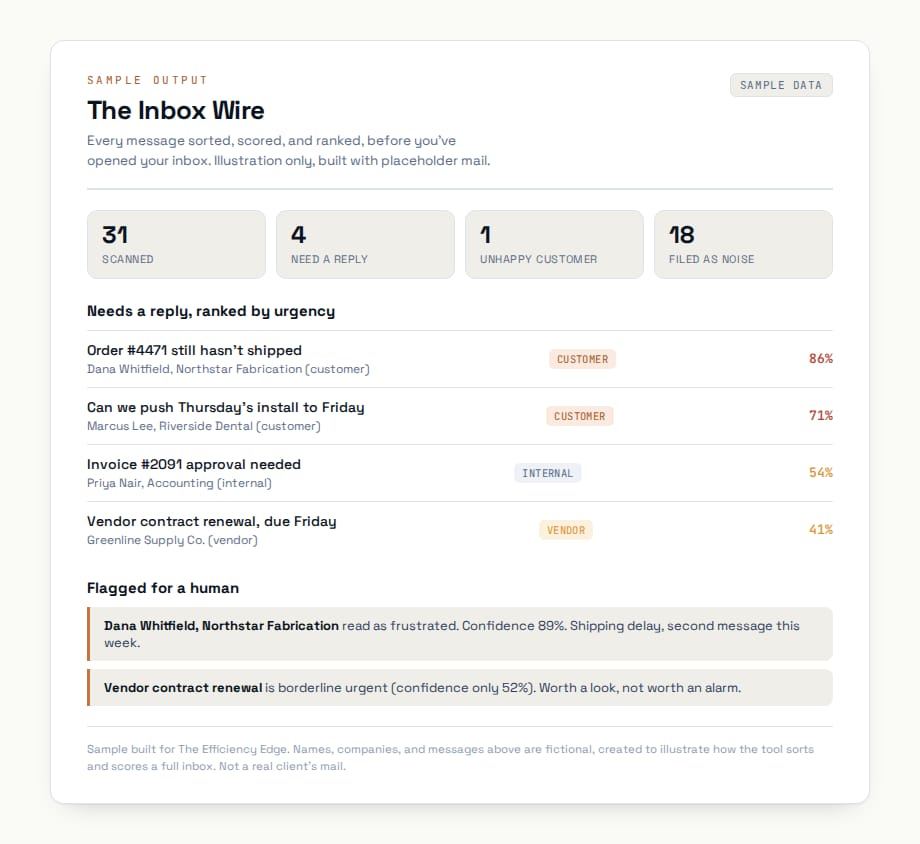
The day this new model launched, we tested it. Not in theory. On a live inbox, sorting real mail into what needs a reply, what’s a frustrated customer, what’s noise, and how urgent each one actually is, then ranking it all into a morning briefing before anyone opened their email. It worked, and it worked at a fraction of what the same job would have cost running through a full AI model.
Below is a sample of what that looks like (built with fictional data, not anyone’s real inbox):
Three things worth doing with this, starting this week:
- Look at the decisions your team makes over and over, the ones that don’t take real judgment. Those are candidates for the cheap model, not your expensive one.
- Stop paying premium prices for simple sorting. It adds up faster than you think.
- Save the expensive thinking, and the real conversation, for the 10% of decisions that actually deserve it.
This is exactly why we stay on the bleeding edge for you. Most businesses won’t hear about this shift for another year. You’re hearing about it the week it happened, already tested, already working.
Keep Climbing!
John
Get the next issue in your inbox.
One email every two weeks — practical AI for small business owners. Free, and the forwarding kind of good.
Subscribe free →